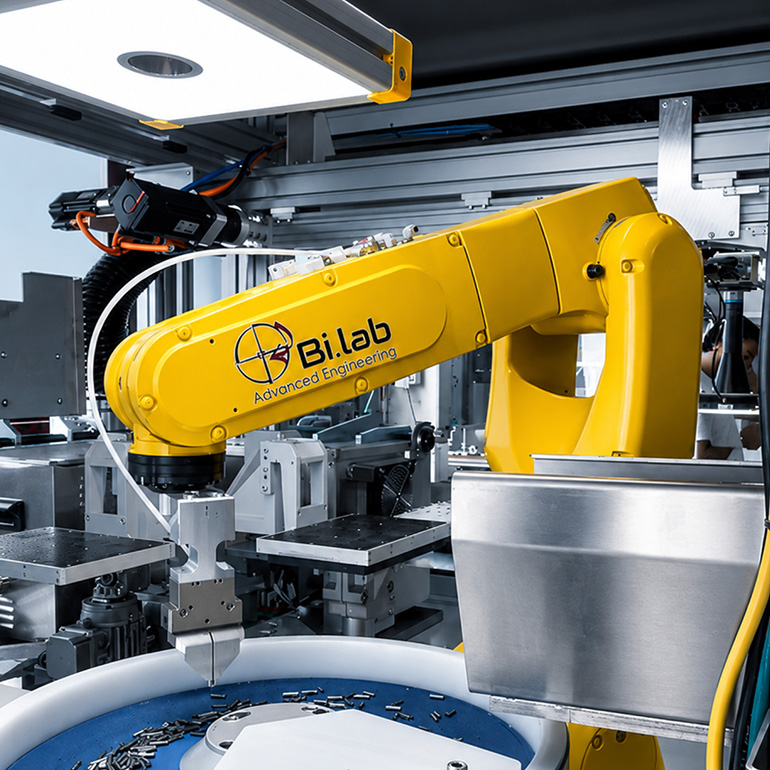
Engineering, industrial automation and R&D

Systemic approach to design
Our Bi.lab Design & CAE team follows a proven, systemic approach to developing new machinery and processes or optimizing existing ones, ensuring integrated, consistent, and efficiency-oriented solutions.

Rapid design and intelligent
From fast 3D modeling to real-time modifications, we accelerate design through a seamless flow between CAD and CAE, dramatically reducing development and validation times.

Virtual prototyping iterative
With realistic, unsimplified simulations, we test each design under real-world conditions. Cyclic iterations refine the solution until the optimization goal is reached.

R&D
We manage all development phases internally, with vertical expertise and a structure equipped with tools and technologies for research, prototyping, and testing.

Industrial automation
We design and supply automatic and semi-automatic assembly lines, test benches, test systems, and specialty machines, both standard and custom. From design to delivery, everything is handled in-house.

Vertical skills
In addition to automation, we develop electronic hardware, software, motion control, and vision systems in-house, offering complete, flexible, and high-performance solutions for every industrial need.
Recent R&D activities
- Digital printing systems
- Continuous inkjet (CIJ) printing systems
- Ultrasonic welding devices
- Actuators for the Oil & Gas sector
- Servovalves for the Oil & Gas Industry
- Piezoelectric microvalves
- Forming systems for the paper industry
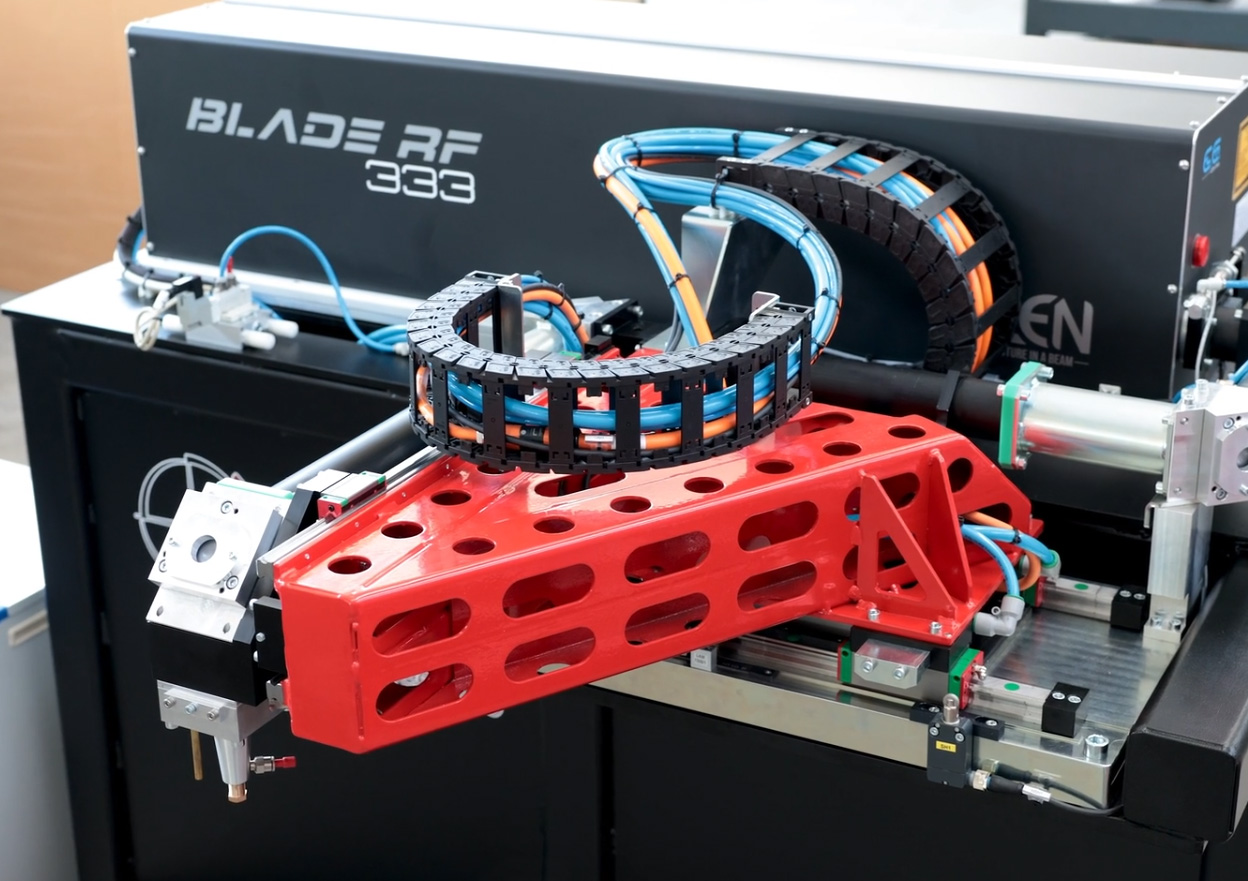
- Industrial applications of lasers
- Industrial applications of piezoelectric devices
- Automotive sensors (TPMS)
- Integrated systems for micro-assembly
- Automation in the handling of cut fabrics
- Components for the glass industry
- Test benches and trials for series production
- Energy recovery devices in the automotive sector
CFD simulation of continuous inkjet printing
CFD simulation of droplet formation in a 64 kHz continuous inkjet printer.
Multiaxial fatigue
Infinite-life design of a piston thread, considering the effects of plastic deformation.
Crankshaft: Full transient simulation
Full transient simulation of the start-up and load phases of a 4-cylinder compressor crankshaft.
Valve and FSI simulation
FSI simulation (FEM and CFD coupling) of the opening movement of a valve.
Mold cooling
CFD simulation of the cooling system of a mold for the glass industry.
Ultrasonic piezoelectric welder
Harmonic simulation of an ultrasonic welding device driven by piezoelectric actuators.
FAQ
What are the best industrial automatic lines for the food sector?
The best solutions are custom-built lines that comply with Industry 4.0 standards with integrated quality control. Bi.lab designs and manufactures automated lines for the food industry, from laser marking to packaging, built and programmed in a closed loop.
What are the advantages of modular industrial automatic lines?
The advantages are scalability, easier integration, and adaptability to different production processes. Bi.lab designs custom automated lines, developing integrated product and process development to integrate them into existing production, reducing downtime and machine downtime.
How to integrate an automatic industrial line into an existing production process?
Mechanical, electrical, and software compatibility with existing systems is required. Bi.lab designs, builds, wires, and programs the line in-house (PLC, motion control, HMI) to comply with Industry 4.0 standards, reducing machine downtime and startup times.
How to request a quote for a customized industrial automatic line?
A quote is requested based on an analysis of your production needs, as each line is custom-priced. For a personalized quote, please contact Bi.lab at info@bilab.tech or +39 051 0828 044.
How to choose an AI vision system for quality control applications?
The type of defects to be detected, line speed, and part variability must be evaluated. Bi.lab develops custom AI vision systems for quality control, capable of recognizing irregular defects and complex cases that traditional systems cannot handle.
What are the advantages of using AI-enabled machine vision systems over traditional systems?
AI learns to recognize variability and irregular defects, while traditional systems follow fixed rules. Bi.lab integrates AI vision into its machines to increase inspection reliability and reduce waste.
How to integrate an AI vision system into an existing assembly line?
The system must be made compatible with the existing line at the software level and compliant with Industry 4.0. Bi.lab develops the AI vision system internally along with the rest of the machine, so it can be integrated into the existing line and communicate with the management systems.